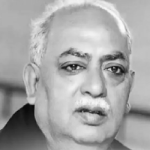
Munawwar Rana (26 November 1952 – 14 January 2024) was one of India’s most beloved and influential contemporary Urdu poets, renowned for his emotionally charged ghazals, nazms, and especially his poignant tributes to motherhood (“Maa”). His commanding stage presence, witty repartee, and use of simple, everyday Hindi-Urdu language (often laced with Awadhi flavor) made him immensely popular at mushairas across India and internationally, earning him the title of a true “people’s poet.”
Early Life
Born as Sayed Munawwar Ali in Raebareli, Uttar Pradesh, to Anwar Rana and Ayesha Khatoon, he came from a modest family profoundly impacted by the 1947 Partition—many relatives migrated to Pakistan. He spent parts of his early years in places like Kolkata before making Lucknow his permanent home, where he lived and created for most of his life.
Literary Career and Style
Munawwar Rana deliberately moved away from heavy Persian-Arabic vocabulary common in classical Urdu poetry, opting instead for accessible, colloquial language that resonated with ordinary audiences. His themes often revolved around love, patriotism, social issues, human emotions, displacement, and above all, the sanctity of “Maa” (mother)—his famous poem on the subject remains one of the most recited pieces in modern Urdu-Hindi literature.Key works include:
- Shahdaba (won the Sahitya Akademi Award in 2014)
- Baghair Naqshe Ka Makan
- Chehre Yaad Rahte Hain
- Various other collections of ghazals and nazms.
He also wrote lyrics for films (notably associated with Maatr in 2017) and received over two dozen awards, including the Maati Ratan Samman (2012), for his contributions to Urdu literature.
Personal Life
He was married to Raina Rana and had five children—including son Tabrez Munawwar Rana (active in preserving and promoting his father’s legacy online) and daughters who have also engaged in writing and poetry.
Known for strong socio-political views, patriotic fervor, and outspoken commentary on issues like migration and national identity, he occasionally courted controversy but remained widely admired.
Death
After battling prolonged illness, including throat cancer and related complications, he was admitted to hospitals in Lucknow (initially Medanta, then Sanjay Gandhi Post Graduate Institute of Medical Sciences – SGPGI). He passed away on 14 January 2024 at age 71 due to cardiac arrest amid multiple organ failure. He was buried in Aishbagh Qabristan, Lucknow.