
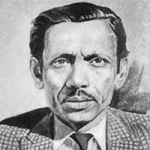
Nasir Kazmi (full name: Syed Nasir Raza Kazmi; Urdu: سید ناصِر رضا کاظمی) was one of the most influential and beloved modern Urdu poets, widely regarded as a founder of the contemporary ghazal style in Urdu literature.
Early Life
He was born on December 8, 1925, in Ambala, Punjab (then in British India, now in Haryana, India). His father, Syed Muhammad Sultan Kazmi, was a Subedar (a non-commissioned officer) in the British Indian Army, and his mother was an educated woman who taught at the Mission Girls School in Ambala. He completed his early education in Ambala and Shimla (Simla), later attending Islamia College in Lahore for higher studies. He returned to Ambala around 1945 and managed ancestral land there until the Partition.
Migration and Life in Pakistan
The Partition of India in 1947 profoundly impacted his life. His family migrated to Pakistan and settled in Lahore, where they were allotted modest accommodations (initially two rooms in an old house in Old Anarkali). Lahore became his permanent home and the city most closely associated with his poetry and personal life. He worked as a journalist, served as a staff editor at Radio Pakistan, and was involved in literary circles.
Kazmi was a contemporary of prominent poets like Faiz Ahmed Faiz and Ahmed Nadeem Qasmi. He admired classical poets such as Mir Taqi Mir, which influenced the melancholic tone in his work, and he received guidance from Hafeez Hoshyarpuri. He began writing poetry around 1940, initially in a romantic style inspired by Akhtar Sherani, before developing his distinctive voice.
Literary Career and Style
Kazmi is celebrated for reviving and modernizing the ghazal form during a time when it had become less prominent. His poetry features:
• Simple, everyday language (using words like “chand” (moon), “raat” (night), “baarish” (rain), and “mausam” (weather))
• Short meters (chhoti behr)
• Deep melancholy, romanticism, and themes of separation, loss, longing, and the pain of Partition
• Vivid imagery drawn from nature, reflecting his love for horse riding, riverside walks, hunting, mountains, birds, and trees.
He often expressed a sense of “ehsaas-e-mehroomi” (feeling of deprivation) and captured the transient beauty of life and moments that cannot be reclaimed—something he believed poetry could preserve.
His major works include:
• Barg-e-Ne (1954) — his debut collection, which gained widespread popularity
• Diwan
• Pahli Barish
• Khwab-e-Nishat (a collection of nazms)
Several of his collections were published posthumously.
Death
Nasir Kazmi passed away on March 2, 1972, in Lahore at the age of 46 due to stomach cancer. His life was marked by modest circumstances and health struggles, but his poetic legacy endures as one of quiet emotional depth and timeless appeal in Urdu literature.
His ghazals continue to resonate for their simplicity, beauty, and ability to evoke profound feelings of love, nostalgia, and human vulnerability.